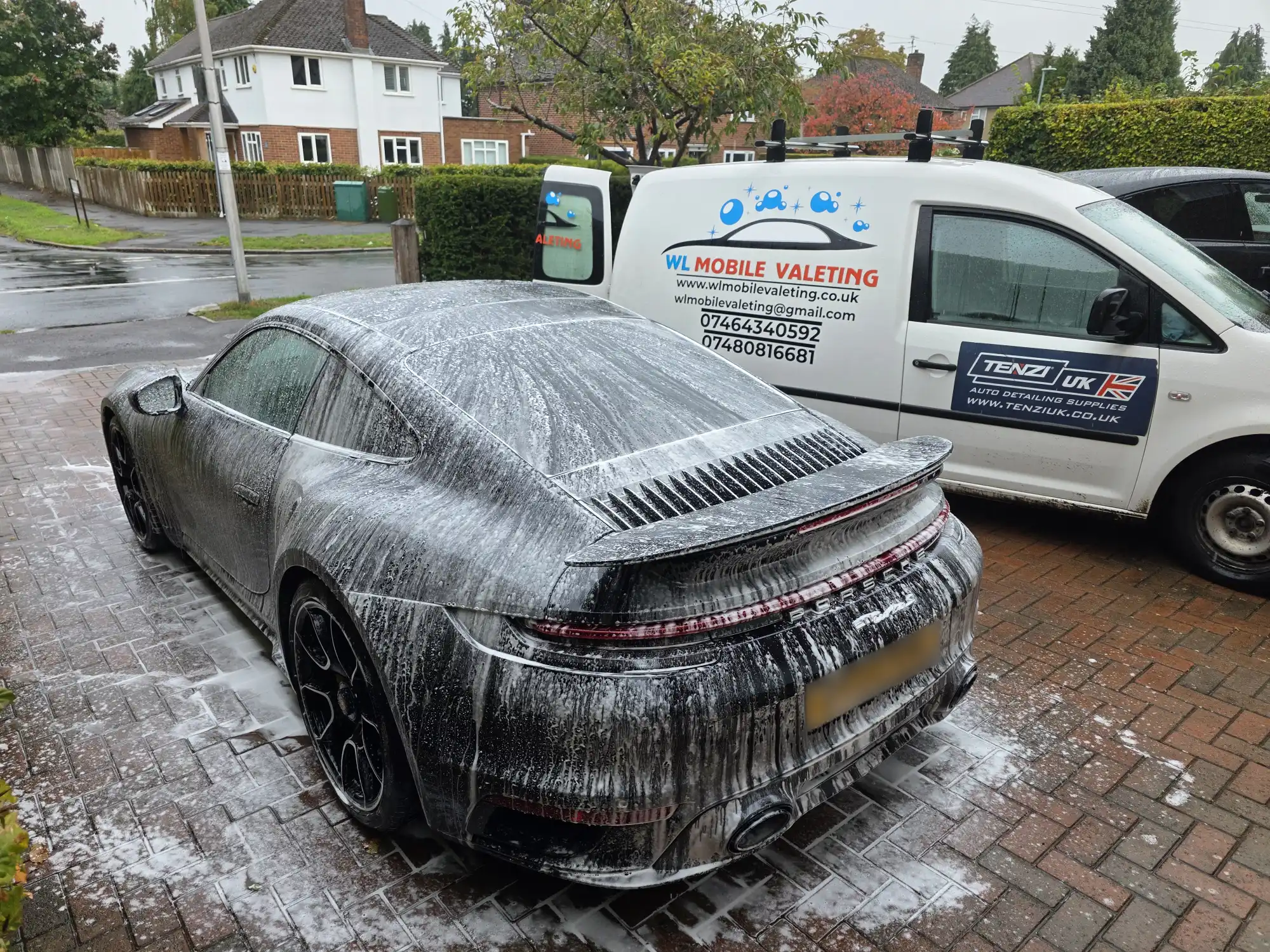
A car door needs roughly ninety centimetres to swing fully open. A valeter needs that space and more, on every side of the vehicle, for the whole time they’re working on it. Get the space wrong, and you end up with a rushed job, a valeter squeezing between wing mirrors, or a booking that has to move somewhere else entirely.
Most driveways and parking spaces work perfectly well. This guide covers exactly how much room is genuinely needed, and what to do if your space falls short.
The Basic Space Requirement
As a general guide, a valeter needs about a metre of clear space around each side of the car, front and back included. That gives enough room to open doors fully, walk around the vehicle without brushing against it, and access the boot and bonnet without contorting around obstacles.
For a standard car in a single driveway or parking bay, this usually isn’t a problem. Most residential parking spaces are wide and long enough to accommodate a car plus a reasonable working margin, particularly if nothing else is parked directly alongside it.
Why Door Access Matters So Much
Interior valeting depends entirely on getting doors open fully, not just cracked. Vacuuming footwells, cleaning door shuts, and treating interior panels all require a door swung right back, sometimes for extended periods while other work happens nearby.
A car wedged between a wall and another vehicle, with doors barely able to open a third of the way, turns a straightforward interior clean into an awkward one. Some tasks can’t be done properly at all in that position, which is why space around the doors matters more than almost anything else on this list.
Space Needed for the Boot and Bonnet
Boots need clearance behind the car, ideally enough to lift the boot lid fully and lean in comfortably. A car reversed tight against a wall or another vehicle often can’t open its boot past a narrow gap, which makes cleaning the boot space and boot lid genuinely difficult.
The bonnet matters less for a standard valet, but it becomes relevant for engine bay cleaning or when access is required for screenwash top-up. A little space at the front avoids the awkward business of trying to prop a bonnet open in a tight gap.
Working Around Tight Driveways
Narrow driveways, particularly ones shared between two properties or squeezed beside a garage, are the most common space issue a valeter runs into. If one side of the car sits within a few inches of a wall or fence, that entire side becomes far harder to work on properly.
Moving the car slightly, even by a metre or two, often solves this without needing to relocate anywhere else. A valeter would rather ask you to shift the car forward or back by a small amount than attempt a full valet with one whole side effectively inaccessible.
Parking Next to Other Vehicles
Cars parked close together on a shared drive or in a communal car park cause the same problem from a different angle. If your car sits within touching distance of a neighbour’s vehicle, that side loses most of its usable working space, regardless of how wide the driveway itself is.
Where possible, leaving a gap of at least a metre between your car and anything parked beside it makes a genuine difference to how thoroughly that side can be cleaned. If moving either vehicle isn’t an option, mention it when booking so a valeter can plan around it rather than discovering the issue on arrival.
What Happens If Space Is Genuinely Tight
Not every job needs to be turned away over limited space. A valeter can often still complete a full exterior wash and a decent interior clean even in a tighter spot, working around the constraints as best they can. What tends to suffer is anything needing sustained access to one full side of the car, like machine polishing or careful paint correction work, which genuinely needs room to manoeuvre equipment safely.
If your regular parking spot is on the tight side, a quick call before booking lets a valeter suggest alternatives, whether that’s a different time when a neighbouring space is free, or a slightly different spot nearby that gives more room to work properly.
Space for Machine Polishing and Coating Work
Jobs like ceramic coating and machine polishing need more space than a standard wash, partly because the equipment itself takes up room and partly because these jobs run for several hours rather than one. A valeter needs consistent access to every panel without repeatedly working around obstacles, so a slightly more generous space than usual makes a real difference to the finished result.
Sorting Space Out Before You Book
If you’re unsure whether your driveway, parking bay, or communal space gives enough room, mention it when you book rather than waiting until the day. Get in touch with WL Mobile Valeting, describe where the car will be parked, and a quick chat beforehand will confirm whether the space works as it stands or needs a small adjustment on the day.